
Puppy Tips
Puppy Tip: Teach Your Puppy to Focus Around Distractions
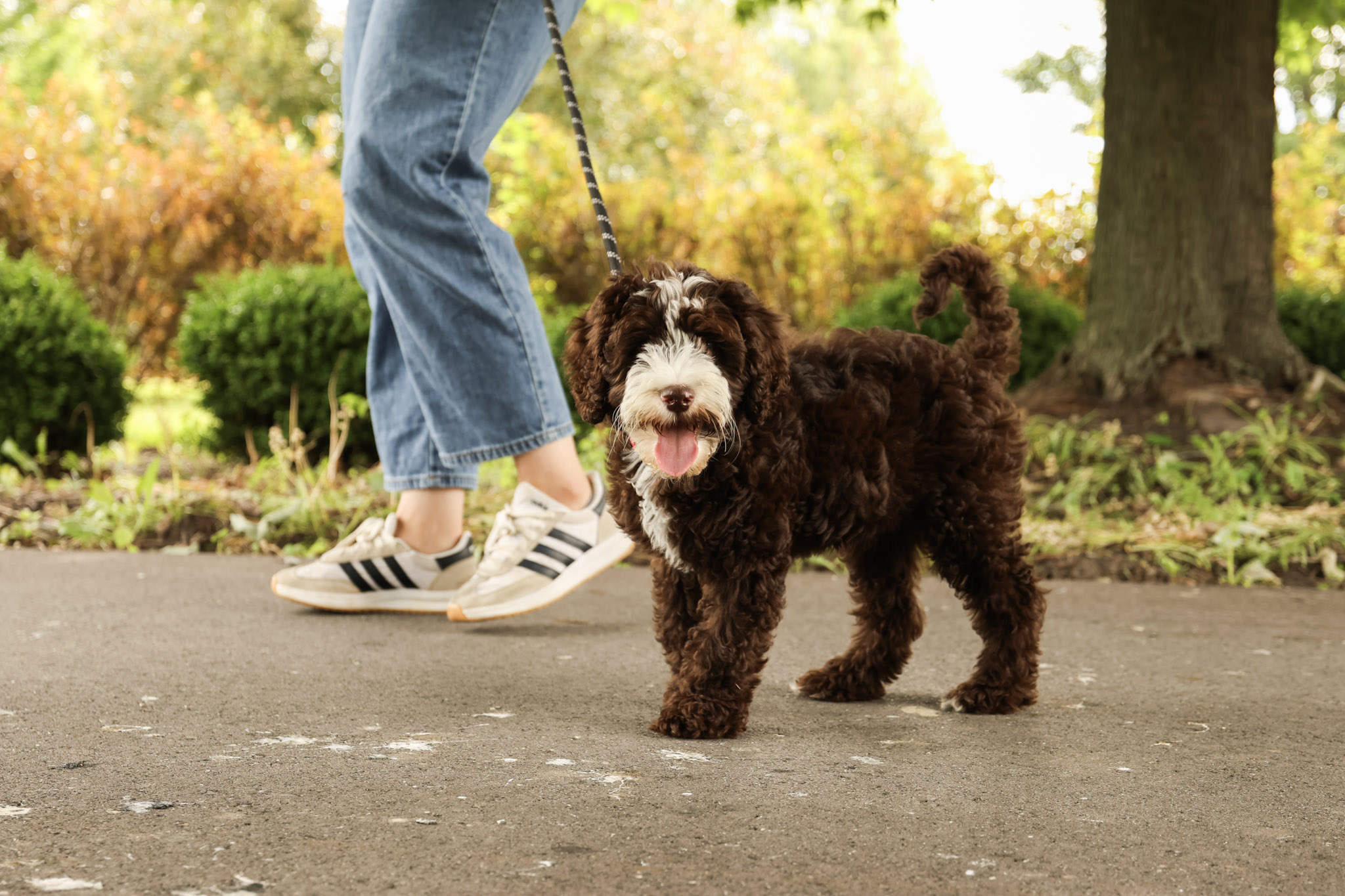
Does your puppy pull toward people or other dogs while out on a walk? Do they become overly excited when someone new is nearby? Do you wish your puppy would focus on you instead of the latest distraction?
Here’s a helpful training mindset: Think about what you want your dog to do, rather than what you don’t want them to do.
Instead of thinking, “I don’t want my puppy to pull toward that person,” ask yourself, “What would I like my puppy to do instead?”
Maybe you want your puppy to look at you and wait for further instruction. You may eventually want to add a sit or down while they remain focused on you. Once you know the behavior you want, you can break it into small, achievable steps.
Start small. Imagine you are out walking and your puppy notices a stranger approaching. Your first goal may simply be for your puppy to look at you.
Begin by using a small food reward to gently guide your puppy’s attention toward you. The moment they look at you, mark the behavior with “Yes!” and reward them.
Repeat the exercise while gradually increasing the amount of time your puppy focuses on you. First, have your puppy look at you, mark the behavior with “Yes!” and reward them. Next, have them hold their attention for three seconds before marking and rewarding. Then, try five seconds, followed by 10 seconds. Gradually build up to 15 or 20 seconds and beyond.
Continue rewarding your puppy while the person passes. Once the distraction is gone, put the food rewards away and continue your walk.
If you would like your puppy to sit or lie down while focusing on you, first make sure they understand those behaviors in a low-distraction environment.
Once your puppy is looking at you, give the cue “sit” or “down.” If they are still learning, use a food reward as a lure to help guide them into the desired position. When they complete the behavior, mark it with “Yes!” and reward them.
Continue offering small rewards to help your puppy remain in position while the person passes. Then, use your release cue and continue your walk.
To practice, visit a park or another location where you are likely to see people. Each time someone comes close enough to catch your puppy’s attention, practice asking for focus.
If your puppy is too focused on the distraction to respond, simply move farther away. Find a distance where your puppy can notice the person but is still able to look at you and take a reward.
Distance solves a lot of training challenges.
As your puppy becomes more successful, you can gradually practice closer to people and in more distracting environments. Over time, seeing someone new can become a cue for your puppy to check in with you instead of pulling toward the distraction.
Remember to start small, reward often, and build success one step at a time.
About CVL
Colonial Village Labradoodles is Indiana's premier labradoodle breeder. We raise multi-generational Australian Labradoodle and Australian Bernedoodle puppies with a purpose. Our dogs are bred for their therapy-oriented temperaments and allergy-friendly coats.
What is a multi-generational Australian Labradoodle?
Multi-generational Australian Labradoodles are a cross between many different parent breeds. The breed originated in Australia in the 1980s with the intent of creating an allergy-friendly service dog for the blind. Australian Labradoodles are a combination of a Poodle, Labrador Retriever, English Cocker Spaniel, American Cocker Spaniel, and Irish Water dogs. These breeds were hand-selected for specific breed qualities to create the ideal service dog for those with allergies. Since then, the breed has continued on and spread across the world. Australian Labradoodles are now considered their own breed with its own breed clubs (ALAA and WALA).